Saturday, August 16, 2014

Passed ASWB test

I passed !!!!!!!!! Yes...I did it.......... My God, All glory be to you.................. am so glad...............I thank Blessed Mother and my dear Guardian Angel for all that they did to me to get me through this......... ummmaahhhh

Friday, August 15, 2014

Day 14, 15 key concepts and final revision

Few points to add on at the end of the prep, use this the day before you go to test ....
  • while answering the primary thing is to read all the answers put them in order, read specifier the question asks and then choose the answer
  • concerns with safety is primary issue for the worker. ethics is one of the reason which we look into for  guidelines in saving clients and making clinical decisions. issues of child abuse, domestic violence, homicide threat, suicide threat. all are important issues where safety and reporting you must be sure of . remember even "neglect" can trigger child abuse report. once you see child abuse (physical, emotional, sexual, neglect) look out for medical evaluation, reporting as key answers. once u see domestic violence look for key words like safety plan. suicide reporting overlaps confidentiality so is homicide threat. the main attitude we need to carry here is "safety of client" being priority. also abuse and neglect of elderly- report to adult protection services, note down key words for self neglect, financial abuse, using restraints, social isolation and abandonment.
  • also reporting issues varies with state...so look for choice "according to jurisdiction" procedure
  •  suicide and homicide...clarify threat. and if there's plan you have to notify victim and officials and confidentiality overrides here
  • suicide...look for key words hopelessness, history of suicide attempts, if assessment hasn't been done, think of assessing the risk
  • with respect to confidentiality be very careful. even acknowledging or getting to know someone is coming to treatment to you is a breach of confidentiality.  
  • study dsm in terms of how they differ in that class of disorders. childhood disorders differentials and other disorders
  • browse through timeline differences for various disorders. try to note down timeline mentioned in question and answer accordingly also note down expression of symptoms by various kind of population..like how in children, how its manifested in elderly
  • do not look too much in to medications, just brush through much frequent ones used when you are going through them before test
  • note down if its positive or negative questioning style... like which is "NOT" ... you might lose this if you dont pay attention
  • always rule out medical condition, substance use for clinical decision making
  • someone died being mentioned in question.... think about grief
  • persistent belief of having serious illness despite no evidence to prove - hypochondriasis
  • psychological condition converted to physical manifestation symptom - conversion disorder
  • sensate focus intervention -intervention in sexual intimacy issues without intercourse
  • get to know the classification of disorders, you might be tested on this... eg; which of these is not paraphilias
  • borderline PD- unstable relationship, social worker need to keep firm boundaries with clients..always discuss feelings in therapeutic relationship context with clients, calling in between appointments as key words
  • schizoid PD-  loner, like being alone
  • avoidant PD-  lonely, but want to be social
  • developmental issues question, always look for misinterpretation of parents, culture issues, immigration issue, psycho education for parents as key words 
  • "life review " - intervention with elderly, get information about their life, how they lived, attained, in last stage of erickson's theory, you get to involve them much better in intervention.
  • no secrets policy in couples issue to be ensured in couples intervention and treat the common issue they came for and not individual intervention unless domestic violence issue comes up
  • DABDA - denial, anger, bargaining, depression, acceptance (kubler ross stages of grief)
  • TAIIIIGI - trust vs mistrust (birth - 18 month), autonomy vs shame /doubt(18 months- 3 yr), initiative vs guilt (3-6), industry vs inferiority (school 6-12), identity vs role confusion (adolescent developing identity 12-20), intimacy vs isolation (early adulthood 20-40), generativity vs stagnation (creating next generation, parenting 40-65), ego integrity vs despair (meaning  and accomplishment in life,late adult - 65)
  • oedipus complex- castration anxiety, electra complex- penis envy
  • Seperation anxiety  begins 6-8 months, peaks in intensity 14-18 m, until about 2 and dimnishes
  • ASS - Margret Mahlr's staes of development A - autistic (new born- 1 month) S - Symbiotic (fusion with mother, child think its one with mother and not a separate individual 4- 6 wees - 5 month) ,  S- Seperation individuation (Hatching, Practicing, Rapprochement (beginning, crisis, solution))
  • SPCF - Jean Piaget's theory of cognitive development . S- sensorimotor (birth -2) object permanance , P- Pre operational (2-6) ego centrism , concrete operations stage (6-12) conservation , F- formal operations (12 and above) abstract thinking and concentration
  • PSBSS - Maslow's heirarchy of needs P- physiological, S-  safety, B- belonging, S- self esteem, S- self actualization
  • PCP - Lawrence kholberg's theory of moral development. stages include Preconventional morality(2-4,obedience and punishment orientation, 4-7 self interest orientation) , Conventional morality(7-10 social conformity, 10-12 law and order orientation) and post conventional morality(teens- social contract orientation, adult- universal ethics orientation)
  • AAIPIU- Authoritative parenting(displaying rational control, warmth and responsiveness, promoting independance-assertive, self confident, achievement oriented children), authoritarian parenting(high control and little warmth, hostile, rebellious withdrawn children with low self esteem and poor achievement), indulgent - permissive parenting(warm and caring but provide little control and make few demands, children are indulgent, frustrated, low in achievement), indulgent - uninvolved parenting(less time and effort in parenting, these children have low self esteem, delinquent, rebellious, impulsive, moody, aggressive) - Diana Baumrind parenting styles
  • MSE - mental status exam - different domains- appearance, attitude (resistant, eager, over optimistic), behavior, mood and affect (flat, elevated, connected or disconnected presence), speech, thought process, content of thoughts, perceptions, cognition, insight, judgement
  • in issue of terminating client, we can never abandon the client, common response to termination is feeling of being fearful to able to handle issues without therapist, crisis around termination doesn require termination, reactions are common.
  • Medications important for social workers knowledge include lithium - associated with Bipolar Disorder , has adverse side effects.
  • Typical antipsychotics (Psychotic Disorders) • Chlorpromazine (Thorazine) • Haloperidol (Haldol)
  • Atypical antipsychotics (Psychotic Disorders) • Risperidone (Risperdal) • Olanzapine  (Zyprexa)  Quetiapine (Seroquel) • Ziprasidone (Geodon) • Aripiprazole (Abilify) 
  • SSRI’s (Depression/Anxiety) • Fluoxetine (Prozac) • Citalopram (Celexa) • Sertraline (Zoloft)   Paroxetine (Paxil) • Escitalopram (Lexapro) Mood Stablizers (Bipolar) • Lithium • Divalproex Sodium (Depakote) • Carbamazepine (Tegretol) • Lamotragine (Lamictal) • Oxcarbazepine (Trileptal) Benzodiazepines (Extreme Anxiety/Panic) • Clonazepam (Klonopin) • Lorazepam (Ativan) • Alprazolam (Xanax) 
  • Stimulants (ADHD) • Methylphenidate  (Ritalin, Metadate, Concerta, Daytrana) • Amphetamine (Adderall) • Dextroamphetamine (Dexedrine, Dextrostat
  • get to know the theories. its not tuf. associate the theories with the concepts and developers. some key theories and key words include                                                                                                      behaviorist theory - operant conditioning, classical conditioning , positive and negative reinforcement, punishment,                                                                                                                  CBT - thinking about people and problem,                                                                                        structural family therapy (salvador minuchin)-  system approach -  key concepts- boundries, heirarchy, subsystems, childrens problems are due to boundary between parents and between parents and children, mimesis, structural mapping, raise intensity so system change                                           task centered therapy/ social work practice - 6-8 weeks short term problem solving, concrete plan to intervene, goal oriented.                                                                                                            psychodynamic -  freud's approach, unconscious, defense mechanisms - primitive (denial, regression, projection, reaction formation,  ), mature(displacement,) and advanced defense mechanisms(sublimation - unacceptable feeling is made in a way acceptable, like sarcasm and kidding around, getting hard workout to deal with unwanted sexual impulse), insight and understanding into past is another key word for identifying with psychodynamic approach                                                 feminist the and social learning th-                                                                                                 problem solving model          
       Bowen family therapy -  key concepts differentiation of self, triangulation, multi generational       
        transmission process, emotional reactivity      
  •       Experiential family therapy -  carl whittaker, virginia satir- key concepts - honest emotion, supress emotion, mystification, blaming, placating, sculpting, conjoint family drawing, choreography, role playing                  
  • never accept bartering, dual relationships, these always come in way of quality of treatment and therapeutic relationship
  • alderian psychotherapy appropriate for issues of goal direction, existential psychotherapy for high functioning individuals, 
  • boundaries is another important issue. here comes transference (client rings up feelings regard to worker) and counter transference (worker affected by client) issues, dual relationship, overlap in relationship, be clear on value differences and never let it in therapy process, in terms of dilemma go for supervision
  • go through ethics before the day of the exam. its very important which guides in your clinical diagnosis or decision making
  • what's privilege ? term related to confidentiality in terms of legal context. where the social worker need not reply to the subpoenas other than from judge. however privilege is waived in number of other conditions like self exposed, suing social worker
  • concepts about group, most important is stages of group formation. storming, forming , norming- irving yaloms theory, boston model -  , group process, 
  • team work -  as a part of multi disciplinary team whats the role for social worker in terms of  coordinating services of client
  • advocacy- empowering client on getting services they are entitled to access them themselves. start where the client is. anything about program development has to do with clients need , program evaluation and methods are another area where question is asked. methods of evaluation, best practices, terms associated
  • cultural diversity is another important area. navajo community, asian clients,african american, hispanic is few areas included in test. issues of immigration, cultural shock, eye contact, aggressive talk, are certain areas we could be tested.
  • Some sclaes/test commonly used: Standford binet intelligence scale, wechsler adult intelligence scale, toni- for multicultural clients, MMPI - minnesota multiphasic personality inventory, 16 personality factor questionnaire, Meyers brigs type indicator, edwards personal preference schedule, DAD, dyadic adjustment scale- for marital adjustment, FES family environment scales, the camberwell family interview, assessment tools for children: childhood autism rating scale, children's depression inventory, Draw a person test, kinetic family drawing, vineland adaptive behavior scales, AUI- alcohol use inventory, 

St. Aquinas prayer

Come, Holy Spirit, Divine Creator, true source of light and fountain of wisdom! Pour forth your brilliance upon my dense intellect, dissipate the darkness which covers me, that of sin and of ignorance. Grant me a penetrating mind to understand, a retentive memory, method and ease in learning, the lucidity to comprehend, and abundant grace in expressing myself. Guide the beginning of my work, direct its progress, and bring it to successful completion. This I ask through Jesus Christ, true God and true man, living and reigning with You and the Father, forever and ever.

Amen.

Day, 13

Practice test practice test practice test.......... there is nothing more you should do for the last 3 days...at least last 2 days...focus on remaining relaxed and control your anxiety. proper diet and sleep very important. Because it's going to affect the way you think during the exam.

Try to have a look at the notes and do not do any kind of referencing job these days. try to stay positive and confident. Its not a big thing. Take several deep breaths whenever you feel the tension building up in the system. 

ASWB practice test is very much recommended so you don't go there unprepared to face the software. it eases you to know the virtual environment you are going to face. Take the exam and review the questions.

try to take a break during the exam, drink juice or snack...you can't take the whole exam in 4 hr at a time. Your brain needs nutrients and atleast water to keep your brain fresh to think through all 4 hr...so have a banana.. and try to take a break if see yourself anxious, unfocused because u r getting tired. 

Do not memorize anything hard, just read through as a story where you understand and involve in the matter you are going through.

Have enough sleep and take public transport to the examination facility and above all i strongly recommend PRAYER :-) it works wonders !!!! if someone wants to pray for you, let them do it, do not turn down the invitation, anyway its not going to harm you.......

Tomorrow is my test........ Will update the blog on more tips and notes. 

All the Best and God Bless !!!!!!!!!!!!

Thursday, August 14, 2014

more strategies

1.  Always try to teach others what you have studied, specially those who do not know about your field and encourage them to question or challenge you. You'll be surprised by the different ways you get the questions and the different ways you try to find the answer for it finally to know you have mastered the topic. I always do this with my poor husband. So all those out there who want to take revenge, get your spouse to help you in your career by listening to you for 30 min (a better way to build a relationship too) or if there's no one out there...........use your doll...sounds crazy huh...try out

2.  Always take part in group discussion. theres plenty out in Facebook, skype  and other social media. this helps more than you think, but forget to use the idea during the end of the test. Do it while you are preparing.

3.  Always give the last 3 days for rest. You never know how your mishandled anxiety can treat you. Am suffering with unexplained body aches and fatigue and too tired to even revise my stuff. And there's just one day left for the exam. So never plan till last minute and never push yourself through the final days.

4.  always look for key words and mark them down or scribble them down. Key words are most important. They are specifiers like "should, best, first, next, and in the answers (acknowledge, validate, explore, clarify, assess, refer, etc.

When approaching questions: 

(1) Acknowledge feelings first if given the option (you may also want to validate this is similar to acknowledge, validate what they are FEELING only)
Remember acknowledge simply means you are aware and state what you see
Validation means you can understand how they feel. Sometimes we acknowledge but not validate.
(2) Explore the situation before you clarify
(3) Identify before  clarify, and when you clarify make sure the client is with you and it is mutual so you can be sure they understand
(4) Get client's perspective first (e.g. the client asks the question, what do you think, get client to say what he/she thinks before you give your suggestions)
(5) For the group related questions always bring  it back to the group (unless danger to self or others, mandatory reporting, etc.)
(6) If it is very sensitive in nature the topic the client wants to discuss and you are concerned about the client sharing such sensitive information offer to discuss individually any sensitive topics that may cause harm and/or embarrassment when shared in a group setting. 


Below, is a question and an example on how to put the key words on scrap paper.

Mr.jones is having dialysis and has missed his last two treatments.  In addition, his wife is in poor health and he is the primary caregiver for her.  In discussing his situation, he sees it as hopeless and shows other signs of depression. The client states he wants to quit dialysis and die. A multi-disciplinary team meeting is called.  The social worker should advocate for:

A. letting the client (mr.jones) exercise his right to die
B. evaluating the client for depression
C. suggest that he see a therapist for the depression
D. tell the physician to increase his medicine

Answer B, from these choices is evaluate for depression.  The key words in these answers are: 
letting
evaluating
suggest
tell physician

I would evaluate before I did any of the others.  This man needs to be evaluated for depression he will also need to be evaluated for suicide potential and the answer that says evaluation gets closest to that. 
The team needs this information to make an informed decision on how
to best assist this client.


Wednesday, August 13, 2014

Day 12

Brush through certain concepts to read further and recall necessary test information


  1. What is peer review ?
  2. Jeff vs redmond case vs social work decision making
  3. confidentiality and insurance company
  4. what is vicarious liability?
  5. timeline difference between MDD and Adjustment disorder with depressed mood and acute stress disorder
  6. what is type I error in statistical research?
  7. Albert R roberts 7 stage crisis intervention model?
  8. difference between conduct disorder and disruptive behavior disorder
  9. what are 4 classic "A" s of schizophrenic diagnosis
  10. what is Munchausen's Syndrome.?
  11. what is sancter's disease
  12. what is narcissistic injury?
  13. What does the term "overhead" mean in planning program
The hard lesson learnt is....give more than 10 days before the exam to do the practice test. Then you'll know you need additional 10 days for the set of concepts you faced for first time. 

Tuesday, August 12, 2014

Day 11


1. Anxiety Disorder 
2. Mood Disorder
3. Practice test and additional concepts

Defense mechanisms and disorders - frequently asked question
http://charlessamenowmd.com/wp-content/uploads/2012/06/Defense-mechanisms-and-Personality-Disorders.pdf

Study therapies in key terms too. like distinct goals for each therapy, key words in each therapy, practice identifying therapy using its key concepts, effective therapy for respective disorders etc. follow example below. you may device one by yourself which is much effective than using those done by others.

Rapid change situation -                          Crisis intervention
children -                                           evaluation by play therapy
depression -                                         cognitive therapy, evaluate for suicide
suicide -                                             look out for plan
threat, homicide -                        look out for plan, inform authorities
domestic violence                              safety plan in absence of abusive partner
intervention with children -                   first medical evaluation
borderline -                                          DBT
emphasis on client  -                               rogerian
grief-                                        kubler ross
fatigue -                                          physical examination exclusion
medical condition -                                                 refer
minor -                                             jurisdictional requirement
religion -                                                 belief and values and their meaning
substance abuse -                              difference in dependence and abuse, support group
seperation individuation -                   Mahlr
develop -                                       frued, erickson , piaget stages of development
personality disorders -                  defenses behind
irrational belief -                             REBT

building your own helps you not only with recall but also confidence.

Monday, August 11, 2014

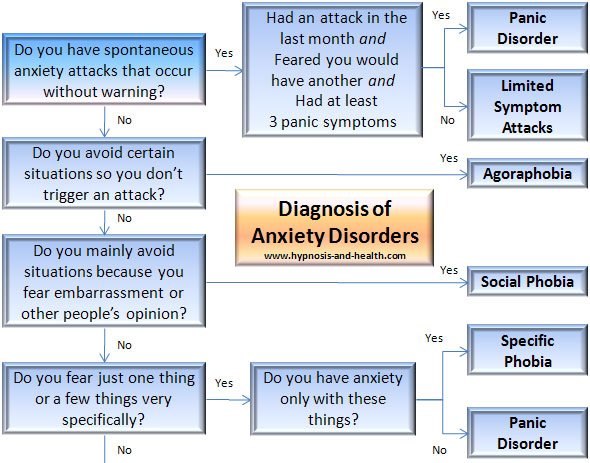
Anxiety Disorders

Disorders in this section include: 


Panic Attack
Agoraphobia
Panic disorder without Agoraphobia
Agoraphobia without history of panic disorder

Specific phobia : Persistent fear of specific object or situation 5 types animal type, natural environment type, blood injection injury type, situational type and other

Social Phobia : fear of social performance situation, exposure to unfamiliar people and scrutiny by others

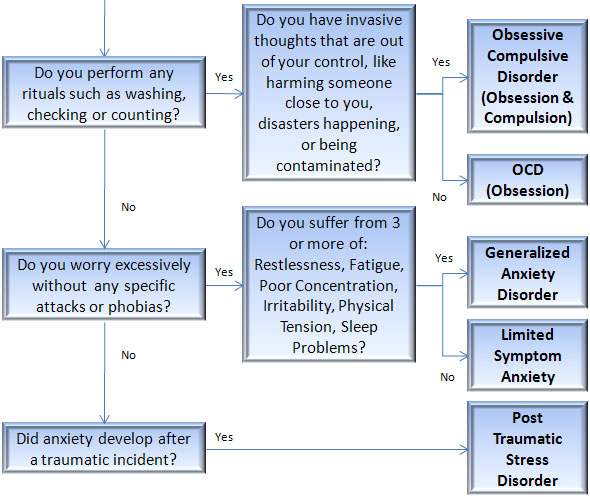
OCD (Obsessive compulsive disorder) = Obsessions (recurrent persistent intrusive thoughts that cause marked anxiety) + Compulsions(repetitive behaviors or acts aimed at preventing or reducing the distress)

PTSD (Post traumatic stress disorder) = exposure to traumatic event + persistently reexperiencing the event + avoidance of stimuli associated with trauma + increased arousal

ASD (acute stress disorder) symptoms occuring within 1 month of extreme stressor and PTSD requires symptoms present for more than 1 month. symptoms lasts from 2 days to 4 weeks and occurs within 4 weeks of traumatic event

GAD (generalized anxiety disorder) - excessive anxiety and worry for at least 6 weeks about a number of issues with difficulty in controlling the worry


To be better prepared for test try to check if you are confident answering these questions and clearly know the differentials

  1. Difference between panic disorder with agoraphobia and without agoraphobia vs specific phobia
  2. Difference between PTSD and ASD
  3. PTSD vs Adjustment disorder vs ASD